
Liquid Acrylic Bathtub Refinishing, Explained
Thinking about refinishing your bathtub? You’ve probably run into the term “liquid acrylic.” Here’s what it actually means, why people use it, and how it relates to the pour-on method we use.
“Liquid acrylic” is one of several names you’ll hear for a poured bathtub refinishing coating — as opposed to one that’s sprayed on. The idea is simple: instead of spraying, a thicker, self-leveling coating is poured over the tub, where it flows out into a smooth, even layer. Different shops call it different things — liquid acrylic, poured coating, pour-on. What matters isn’t the name; it’s the method and the quality of the coating.
What “liquid acrylic” really means
What people are really pointing to is a poured, self-leveling refinishing coating. A few things set it apart from old-style spray:
- It’s poured, not sprayed — so no brush strokes, fibers, or thin bare spots.
- It’s self-leveling — it flows out and evens small imperfections on its own.
- It goes on thicker — a more uniform layer than spray, which is a big part of why it holds up.
- It follows the tub’s shape — so it works even on non-standard tubs, like whirlpool tubs.
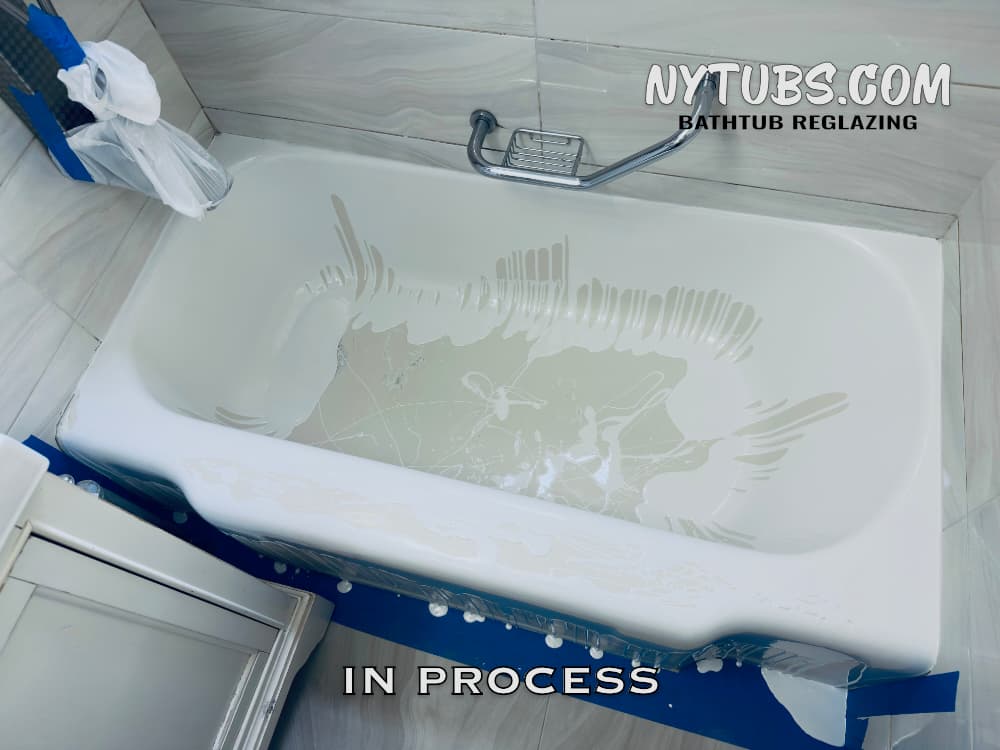
It’s a two-part coating — a base and a hardener mixed on site — with a limited working window once mixed, usually about 60 to 120 minutes. That clock is why it isn’t a good DIY project: the mixing has to be exact and the pour has to be done right, or you end up with an uneven, weak finish that wears off fast. In experienced hands, it self-levels into a clean, even surface with no brush marks.
Frequently asked questions
Is "liquid acrylic" the same as the pour-on method?
Roughly, yes. Both mean a poured, self-leveling coating instead of a sprayed one. “Liquid acrylic” is just one of the names that gets used; what we apply is a pour-on coating, done the same poured way. The method and the quality of the coating matter far more than the label.
Is a poured coating better than spray refinishing?
For durability and finish, yes. A poured coating goes on thicker and self-levels, so there are no brush marks or thin spots, and it lasts far longer than old spray enamel — which tops out around 7 years.
How long does it last?
Up to 15 years with proper care. Skip abrasive cleaners and sharp objects in the tub, rinse and wipe it dry after use, and it’ll keep its smooth finish for years.
Does it smell? Do I need to leave home?
t’s solvent-free, with virtually no odor during the work or while it dries — so there’s no need to vacate the space.
Can I do it myself?
We don’t recommend it. The coating has a short working window once mixed, and the pour has to be done right or the finish comes out uneven and wears fast. A pro typically gets a result that lasts several times longer than a DIY attempt.
Can you use it on any tub?
We refinish cast iron and steel tubs, including non-standard shapes like whirlpool tubs and tubs that had an old acrylic liner removed. We don’t refinish acrylic tubs, sinks, or shower pans.
How this relates to our method
At New York Tubs, what we do is the pour-on method — a poured, self-leveling coating applied to cast iron and steel tubs. If you came here searching “liquid acrylic,” it’s the same basic idea: a poured refinishing coat, not a sprayed one. The coating we use is solvent-free, made for tubs, and built to last. We don’t work on acrylic tubs, sinks, or shower pans — cast iron and steel tubs only, which is where this method does its best work.
What you get from a poured finish
Virtually no smell
Solvent-free, with almost no odor during the work or as it dries — no need to leave home.
Built to last
Resists cracks, chips, peeling, stains, and fading — up to 15 years with proper care.
Fast turnaround
About 3–4 hours to apply, then dry and ready to use in roughly 24 hours.
Even, poured finish
Self-levels into a smooth surface — no brush marks, fibers, or thin spots.
Resists mold & grime
A non-porous surface that shrugs off dirt and microbes; we seal the tub-to-wall corner to keep moisture out.
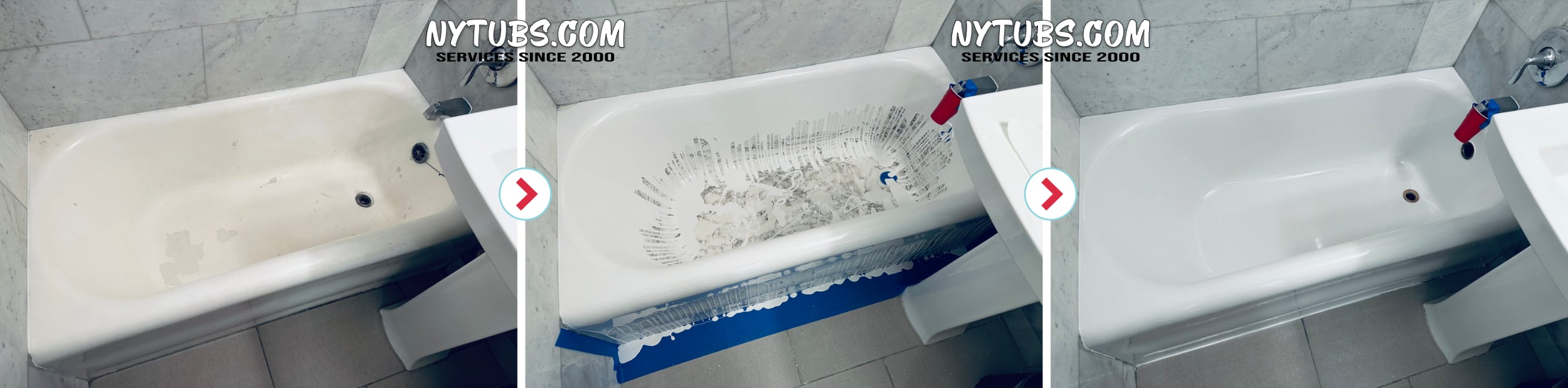
Worn, stained, or damaged tubs are all good candidates. We refinish old enameled cast iron and steel tubs, tubs that have had an old acrylic liner removed, and tubs with deep surface damage — bringing them back to a clean, like-new finish.
Want a poured, like-new finish?
Whether you call it liquid acrylic or pour-on, it’s the same idea — and it’s what we do, on cast iron and steel tubs. Get a free quote and we’ll take it from there.